Early detection saves lives. One of the simplest ways women can take charge of their breast health is by performing Breast Self-Examination (BSE). This simple monthly practice helps women become familiar with how their breasts normally look and feel, making it easier to notice any unusual changes early.
At the Magdalene Iyamu Cancer Foundation (MICF), we believe that knowledge is prevention. Breast cancer, when detected early, is highly treatable. Learning and practicing BSE is an important first step toward early detection.
When Should You Perform BSE?
- Perform BSE once every month
- The best time is a few days after your menstrual period, when breasts are less tender
- If you no longer menstruate, choose the same day each month
Regular checks help you notice changes early rather than waiting until symptoms become severe.
Basic Breast Self-Examination Methods
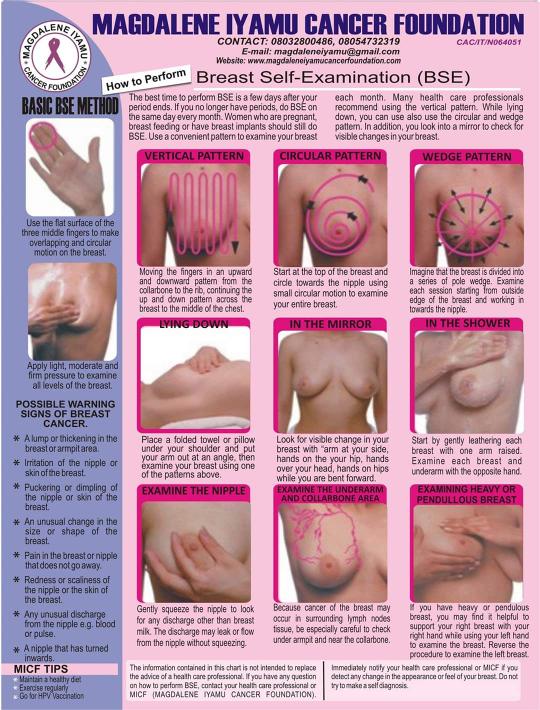
There is no single “perfect” method. What matters most is consistency. The poster highlights three common and effective patterns:
1. Vertical Pattern
Using the pads of your fingers, move your hand up and down vertically across the breast, from the collarbone down to the base, covering the entire area.
2. Circular Pattern
Start from the outer part of the breast and move your fingers in small circular motions, gradually working your way toward the nipple.
3. Wedge Pattern
Imagine the breast divided into sections like slices of a pie. Examine each section from the outer edge toward the nipple.
Use light, medium, and firm pressure to feel different layers of breast tissue.
Check in Different Positions
To fully examine your breasts, it’s important to do BSE in more than one position:
Lying Down
Place a folded towel under one shoulder, raise that arm, and examine the opposite breast. This spreads breast tissue evenly across the chest wall.
In Front of a Mirror
With arms at your sides, raised overhead, and pressed against your waist, look for:
- Changes in size or shape
- Skin dimpling or puckering
- Redness or unusual swelling
In the Shower
Soapy skin allows fingers to glide easily. Examine each breast while one arm is raised.
Don’t Forget These Areas
Breast tissue extends beyond the breast itself. Always check:
- The nipple
- The underarm
- The collarbone area
Gently squeeze the nipple to check for any unusual discharge.
Possible Warning Signs to Watch For
If you notice any of the following, don’t panic — but do not ignore them:
- A lump or thickening in the breast or underarm
- Change in breast size or shape
- Nipple discharge (especially bloody)
- Skin redness, scaliness, or dimpling
- Persistent pain in the breast or nipple
These signs do not always mean cancer, but they should be checked by a health professional.
BSE Is Not a Diagnosis
Breast Self-Examination does not replace:
- Clinical breast examination
- Mammograms
- Medical screening
It is a first line of awareness, not a substitute for medical care. If you notice any change, seek professional advice promptly.
Our Commitment at MICF
At the Magdalene Iyamu Cancer Foundation, we are committed to empowering women with knowledge that saves lives. Through awareness campaigns, screenings, and community education, we help women understand the importance of early detection and timely care.
Call to Action
👉 Book a Screening – Early detection saves lives
👉 Donate – Help us reach more women with breast cancer education and screening support
👉 Book a Free Consultation – Speak to a trained health advocate today
Together, we can reduce breast cancer deaths through awareness, prevention, and early action.